01
Cloud provisioning
Create and remove VPS nodes through supported cloud providers and SSH-reachable hosts.
Beta / Preview ready
Self-hosted infrastructure deployment with a desktop client, Android companion, and Go API. Create a server, deploy multiple protocols, and see the local proxy ports without digging through settings.
PrivateDeploy is not only a local proxy client. It creates VPS nodes, deploys credentials, syncs protocol links, and exposes local ports in one place.
Create and remove VPS nodes through supported cloud providers and SSH-reachable hosts.
Bring up Shadowsocks, Hysteria2, VLESS-Reality, and Trojan when the target plan supports it.
Mixed, HTTP, and SOCKS ports are visible on the overview page and can be copied directly.
Use the Wails desktop app, Android companion, or standalone Go HTTP API for headless workflows.
The desktop app surfaces runtime state, traffic, mode, and local proxy ports in the first view. The cloud panel keeps protocol ports and share links close to each node.
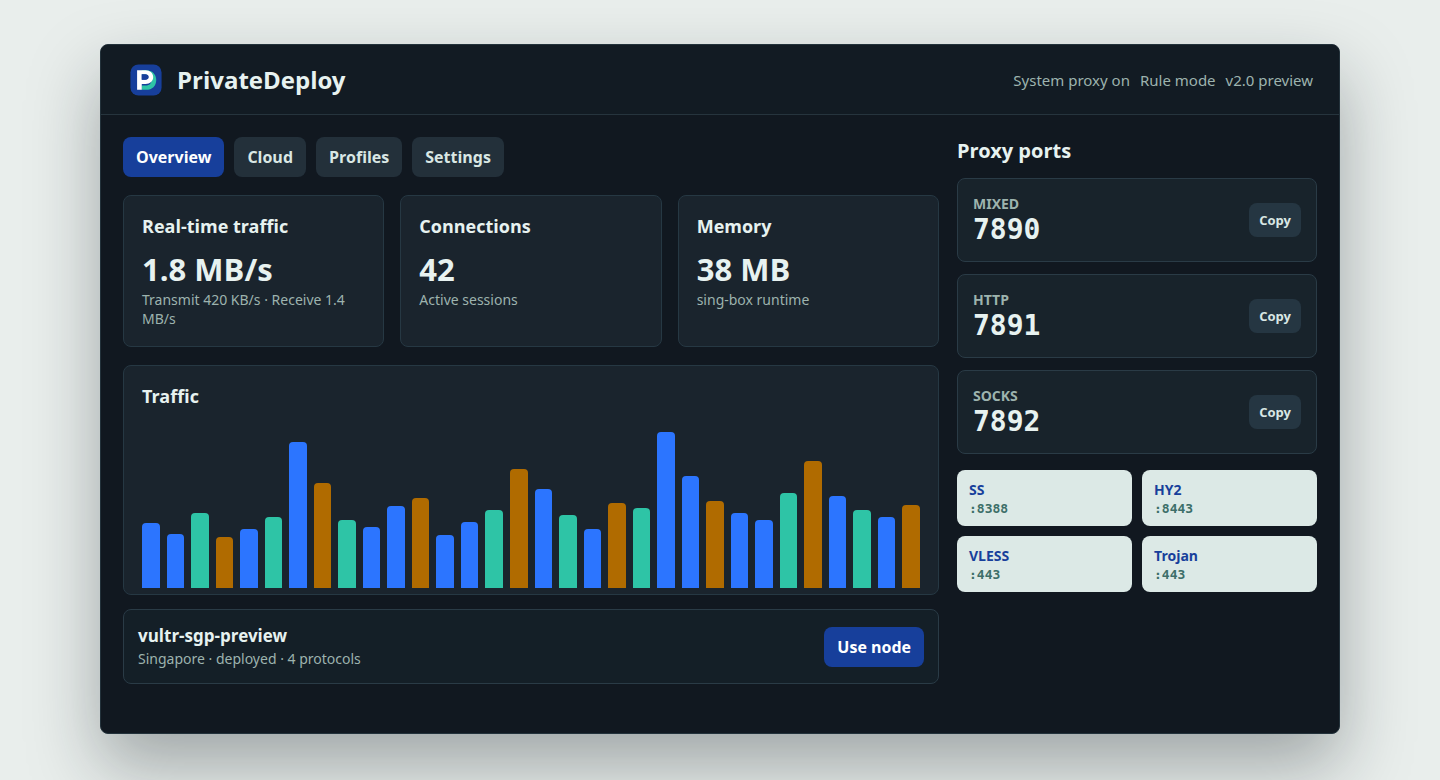
The software has release value today, but the responsible label is Beta / Preview until the full GO/NO-GO checklist passes on real platforms and cloud providers.
The expected path is deliberately short: provide cloud credentials, create a node, review the generated ports and links, then use the endpoint locally or in another client.
Paste a cloud API key or use an SSH-reachable host. Provider credentials stay part of the security model.
PrivateDeploy handles user-data, firewall rules, service setup, and credential persistence.
Use the local Mixed, HTTP, or SOCKS ports, or copy protocol links into sing-box, Clash, v2rayN, or Hiddify.
Start with the release notes and the quick start. Use infrastructure you own or are authorized to manage.